
15 Clever Tiny Hallway Ideas to Organize Smartly
You know that awkward, narrow strip of space that connects your rooms? Yeah, that hallway that you’ve been ignoring since you moved in. I get it – I spent three years pretending mine didn’t exist until I literally ran into my own wall-mounted coat rack one too many times.
Here’s the thing: tiny hallways don’t have to be dead zones. They can actually become some of the hardest-working spaces in your home if you play your cards right. Trust me, I’ve transformed my cramped 3-foot-wide corridor from a cluttered nightmare into an organized, stylish passage that actually makes sense.
Ready to turn that forgotten thoroughfare into something spectacular? Let’s talk about 15 game-changing ideas that’ll make your tiny hallway work harder than your morning coffee.
Mirror-Enhanced Narrow Hallway
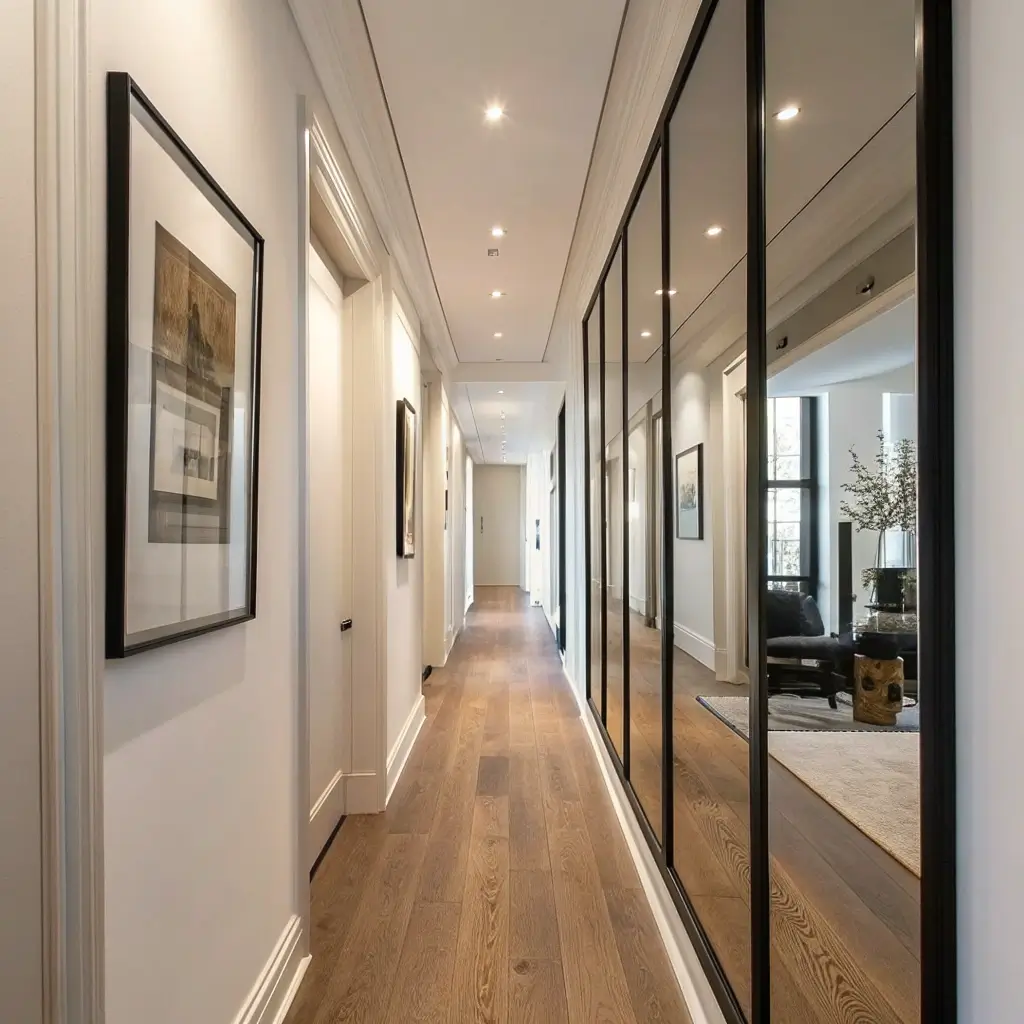
The Magic of Reflection
Ever notice how mirrors basically lie to you about space? And I mean that in the best possible way! Mirrors create instant depth where there isn’t any, and honestly, they’re probably the cheapest renovation trick you’ll ever find.
I installed a floor-to-ceiling mirror at the end of my hallway last year, and suddenly my 8-foot corridor looked like it stretched into another dimension. The transformation shocked even my skeptical partner who thought I was wasting money on “another Pinterest idea.”
Strategic Placement Tips
Here’s what really works when placing mirrors in tight spaces:
- Position mirrors opposite windows if you have any natural light source
- Install them at eye level for maximum impact
- Use multiple smaller mirrors in a pattern if one large mirror feels overwhelming
- Consider mirrored furniture pieces like console tables for double duty
The best part? Mirrors also bounce light around, which means you won’t feel like you’re walking through a cave anymore. My electricity bill actually went down because I stopped needing the overhead light during daytime hours.
Style Considerations
Not all mirrors work equally well in narrow spaces. Frameless mirrors give you the most bang for your buck visually, but framed options can add personality. I personally prefer thin, metallic frames that don’t eat up visual space.
Want to get really creative? Try antiqued or tinted mirrors for a sophisticated vibe that doesn’t scream “I’m trying to make this space look bigger!” Sometimes subtlety wins the day.
Floating Shelves for Small Spaces
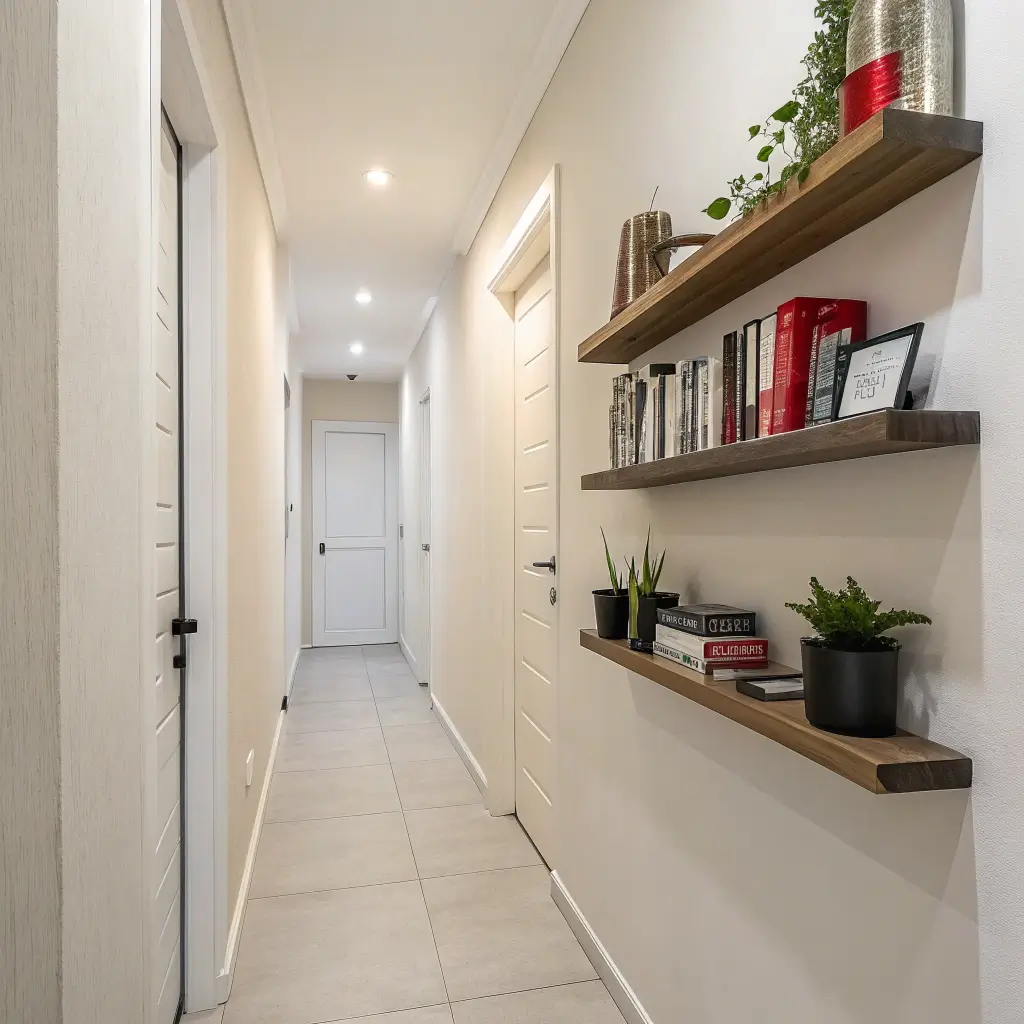
Why Floating Shelves Rule
Floating shelves basically defy gravity while solving all your storage problems. They don’t have visible brackets, which means zero visual clutter – exactly what you need in a cramped hallway.
I installed three staggered floating shelves along my hallway wall, and suddenly I had a place for keys, mail, and those random things that always end up on the kitchen counter. The best part? They take up exactly zero floor space.
Installation and Weight Capacity
Let me save you from my mistakes here. Always find the studs before installing floating shelves. I learned this the hard way when my first shelf came crashing down with all my succulent plants. RIP, little green friends :/
Here’s what you need to know:
- Standard drywall anchors hold about 20-30 pounds
- Stud-mounted shelves can handle 50+ pounds easily
- Measure twice, drill once (seriously, measure three times if you’re like me)
- Keep heavy items closer to the wall for better weight distribution
Styling Your Floating Shelves
The trick with floating shelves in hallways? Keep them minimal. This isn’t your living room where you can display every knick-knack from your travels.
I follow the rule of three: one functional item, one decorative piece, and one plant or book. Any more than that and your hallway starts looking like a garage sale. Less really is more when you’re working with tight quarters.
Minimalist Wall Hooks and Racks
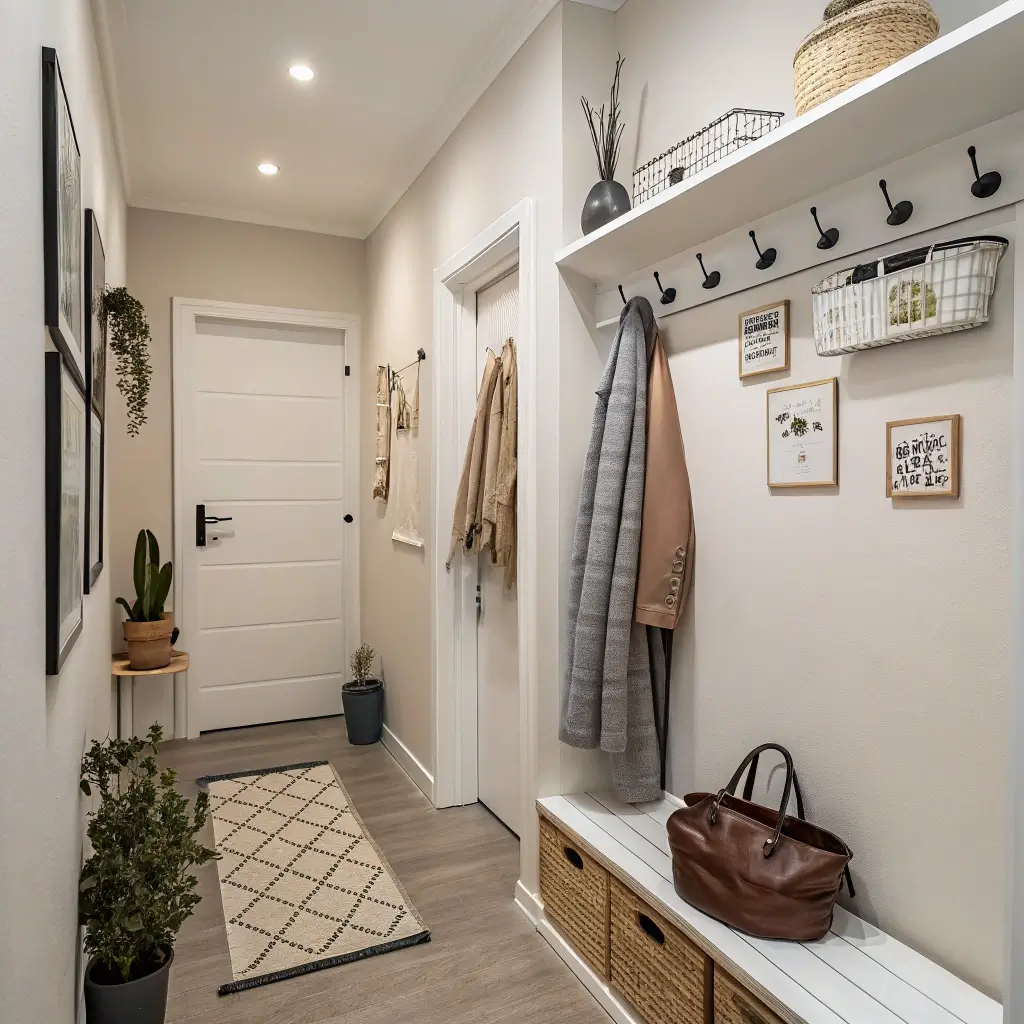
The Beauty of Simple Solutions
Sometimes the oldest tricks work best, right? Wall hooks are basically the unsung heroes of hallway organization. They’re cheap, easy to install, and surprisingly versatile.
I’ve got a row of five simple wooden hooks near my front door that hold everything from dog leashes to reusable shopping bags. Total cost? Under twenty bucks. Total life improvement? Priceless.
Choosing the Right Style
Not all hooks are created equal. Here’s what I’ve learned through trial and error:
- Single hooks work better than multi-hook racks in narrow spaces
- Folding hooks that lay flat when not in use are genius for super tight spots
- Materials matter: wood adds warmth, metal looks modern, ceramic adds personality
- Space hooks 6-8 inches apart for maximum functionality
Creative Hook Placement
Who says hooks only belong at shoulder height? I installed some near the floor for backpacks and gym bags – game changer! Kids can actually reach their stuff, and adults don’t have to bend down to pick things up off the floor.
Another spot people forget? Behind doors. Every door in your hallway is potential storage space. Just make sure you leave enough clearance so the door can still close properly.
Bright Color Accents on Walls
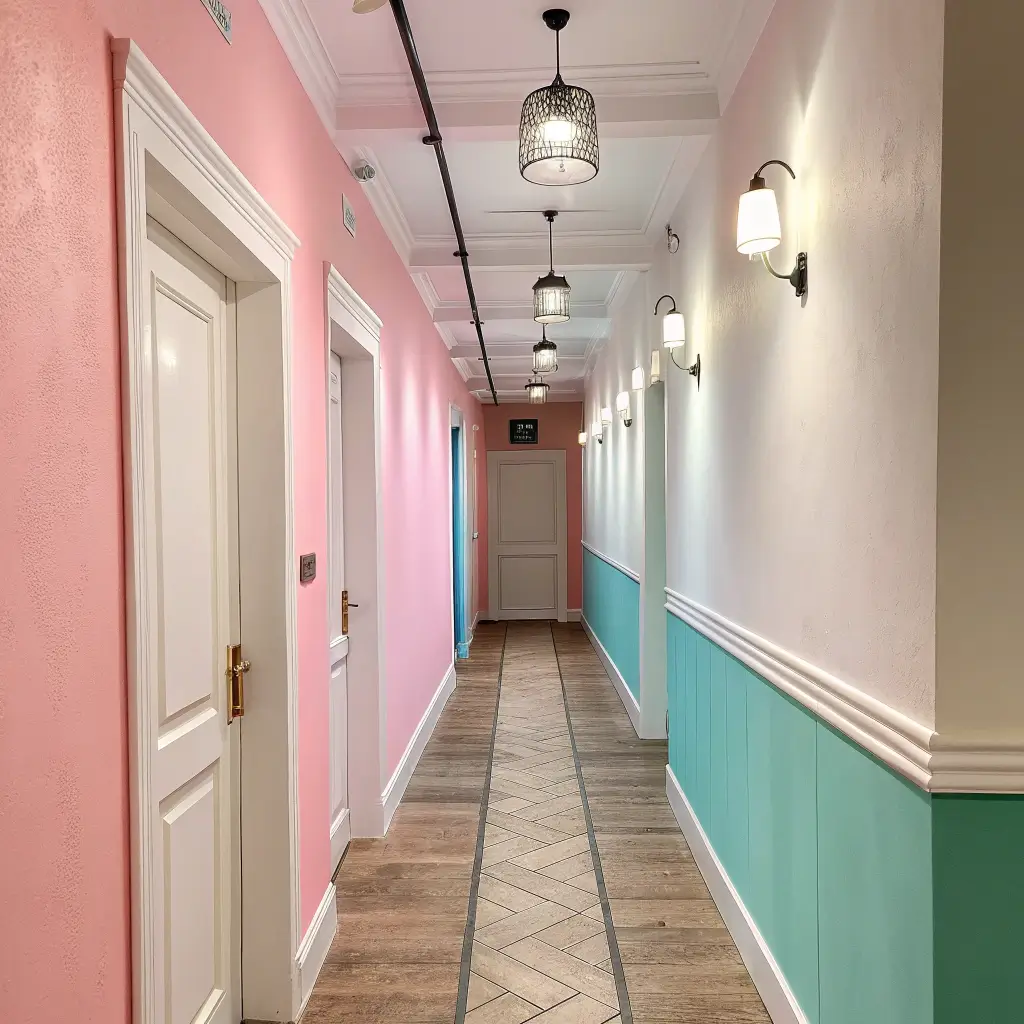
Psychology of Color in Tight Spaces
Okay, I know what you’re thinking – “Won’t bright colors make my hallway feel smaller?” Nope, not if you do it right. The key is strategic placement, not painting every surface neon yellow.
I painted just one wall in my hallway a bold teal, and it completely transformed the vibe. Instead of feeling cramped, it now feels intentional and designed. Plus, it makes walking through way less boring.
Best Colors for Small Hallways
Through much experimentation (and repainting), here are the winners:
- Soft sage green: calming and surprisingly spacious-feeling
- Warm terracotta: adds depth without overwhelming
- Deep navy: creates drama and actually recedes visually
- Sunny yellow: instant mood booster (use sparingly though)
Accent Wall Techniques
The two-thirds rule works wonders here. Paint your wall color only two-thirds of the way up, leaving the top third white. This draws the eye upward and makes ceilings feel higher.
Want something more subtle? Try color blocking with geometric shapes. I’ve seen people use painter’s tape to create triangles or hexagons in contrasting colors. Looks designer, costs practically nothing.
Slim Console Table with Storage
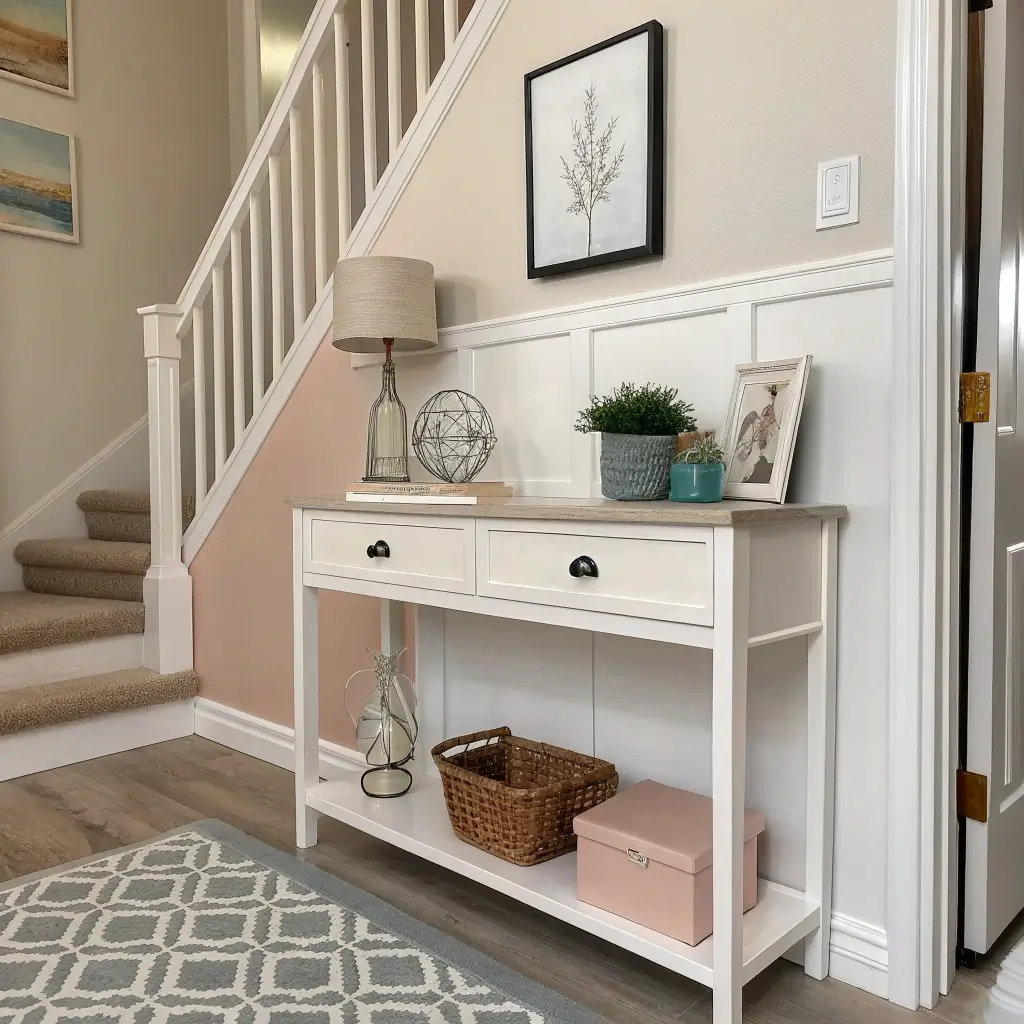
Finding the Perfect Fit
Console tables in hallways are like that perfect pair of jeans – when you find the right one, everything just works. The magic number is 12 inches – that’s the maximum depth you want for a hallway console.
I hunted for months before finding my perfect match: a vintage piece that’s only 10 inches deep but has two drawers and a lower shelf. It holds mail, keys, and even has a charging station hidden inside. Multi-tasking furniture FTW!
DIY vs. Store-Bought Options
Here’s my honest take: DIY can work if you’re handy, but sometimes it’s worth buying the right piece. I tried making my own from an old shelf and hairpin legs, but it looked… well, like a shelf with hairpin legs.
If you go the DIY route:
- Use reclaimed wood for character
- Wall-mount it to save floor space
- Add small baskets or boxes underneath for hidden storage
Styling Your Console
Keep your console table from becoming a dumping ground with these rules:
- One statement piece (lamp, vase, or sculpture)
- A small tray for daily essentials
- Nothing taller than 12 inches if it’s against a wall with art
- Rotate decorative items seasonally to keep things fresh
Gallery Wall of Small Frames
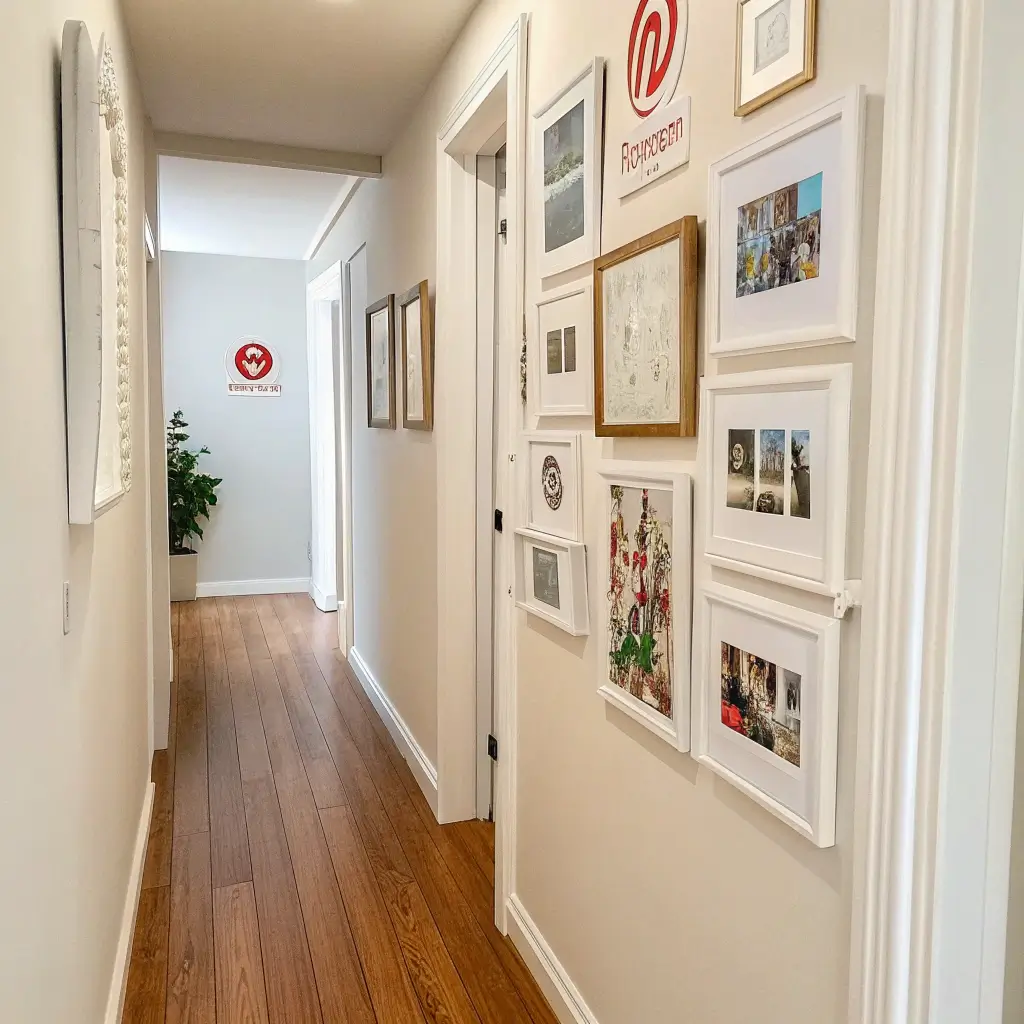
Creating Visual Interest Without Overwhelm
Gallery walls in hallways can either look amazing or like you raided a thrift store and hung everything you bought. The difference? Planning and restraint.
Start with a theme. Mine features black and white family photos mixed with simple line drawings. Keeping the color palette limited prevents visual chaos in the narrow space.
Frame Selection and Arrangement
Small frames work better than large ones in tight hallways – shocking, I know :). But here’s what might surprise you: mixing frame sizes actually makes the space feel larger than uniform frames.
My arrangement strategy:
- Start with the largest piece as an anchor
- Work outward in a organic pattern
- Keep 2-3 inches between frames
- Use paper templates before hammering any nails
Lighting Your Gallery
Nobody talks about this enough, but proper lighting makes or breaks a gallery wall. Picture lights might be overkill for a hallway, but a well-placed sconce or track light can work wonders.
I installed LED strip lights along the ceiling edge, angled toward the wall. Cost me less than fifty bucks and makes my amateur photography look almost professional.
Also Read: 15 Beautiful Hallway Paint Colors Ideas for Bright, Cozy Homes
Vertical Planters and Greenery
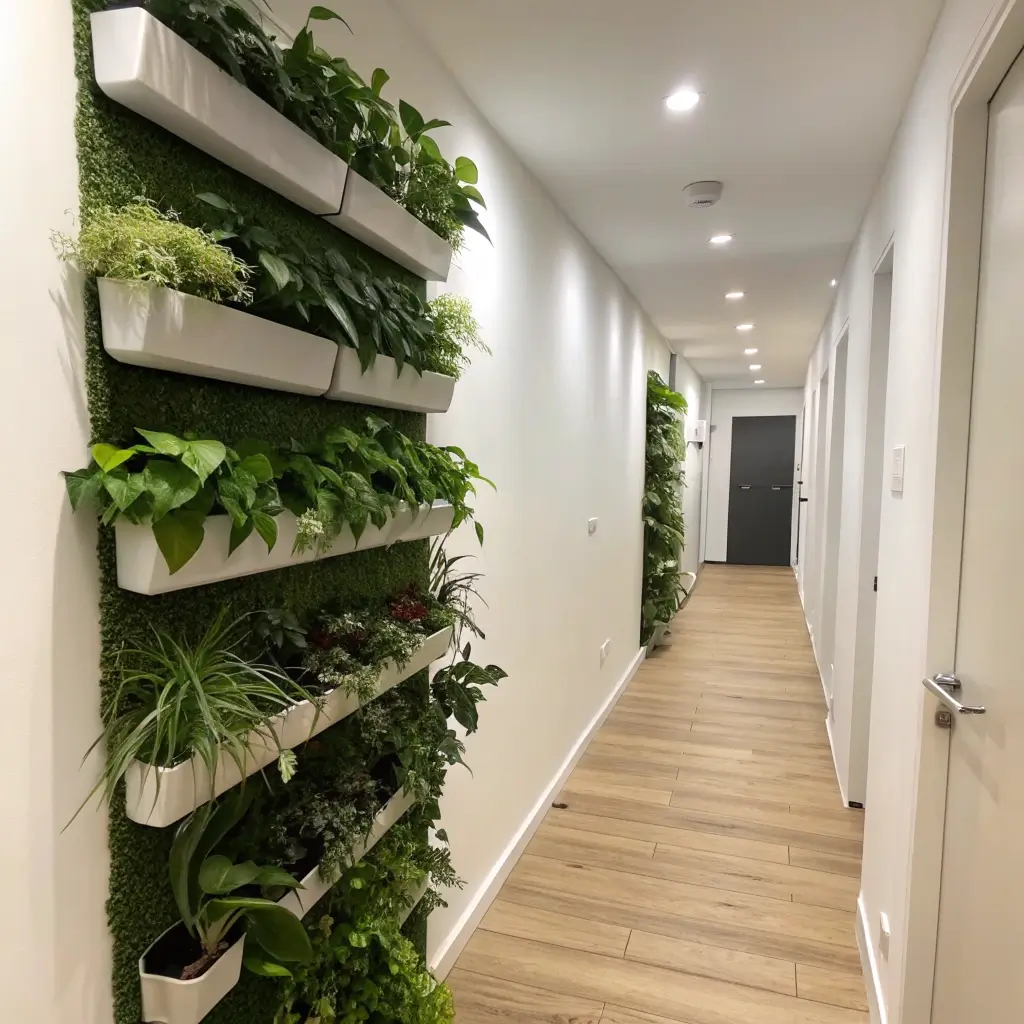
Going Green in Tight Spaces
Plants in hallways might seem counterintuitive, but vertical planters are space-saving miracle workers. They add life, literally, without eating up precious floor or surface space.
I’ve got a living wall of pothos and philodendrons that everyone comments on. The secret? A simple grid system I found online that holds small pots against the wall. Takes up maybe 4 inches of depth total.
Best Plants for Hallway Conditions
Hallways typically have less light and air circulation, so choose your green friends wisely:
- Pothos: practically indestructible
- Snake plants: thrive on neglect
- ZZ plants: low light champions
- Air plants: no soil needed, minimal maintenance
Maintenance Tips
Real talk: hallway plants will die if you forget about them. I set phone reminders for watering because out of sight equals out of mind. Also, rotate your plants occasionally so they don’t grow lopsided reaching for light.
Pro tip: fake plants have come a long way. No judgment if you go artificial – sometimes that’s the smartest choice for busy people.
Patterned Runner Rugs
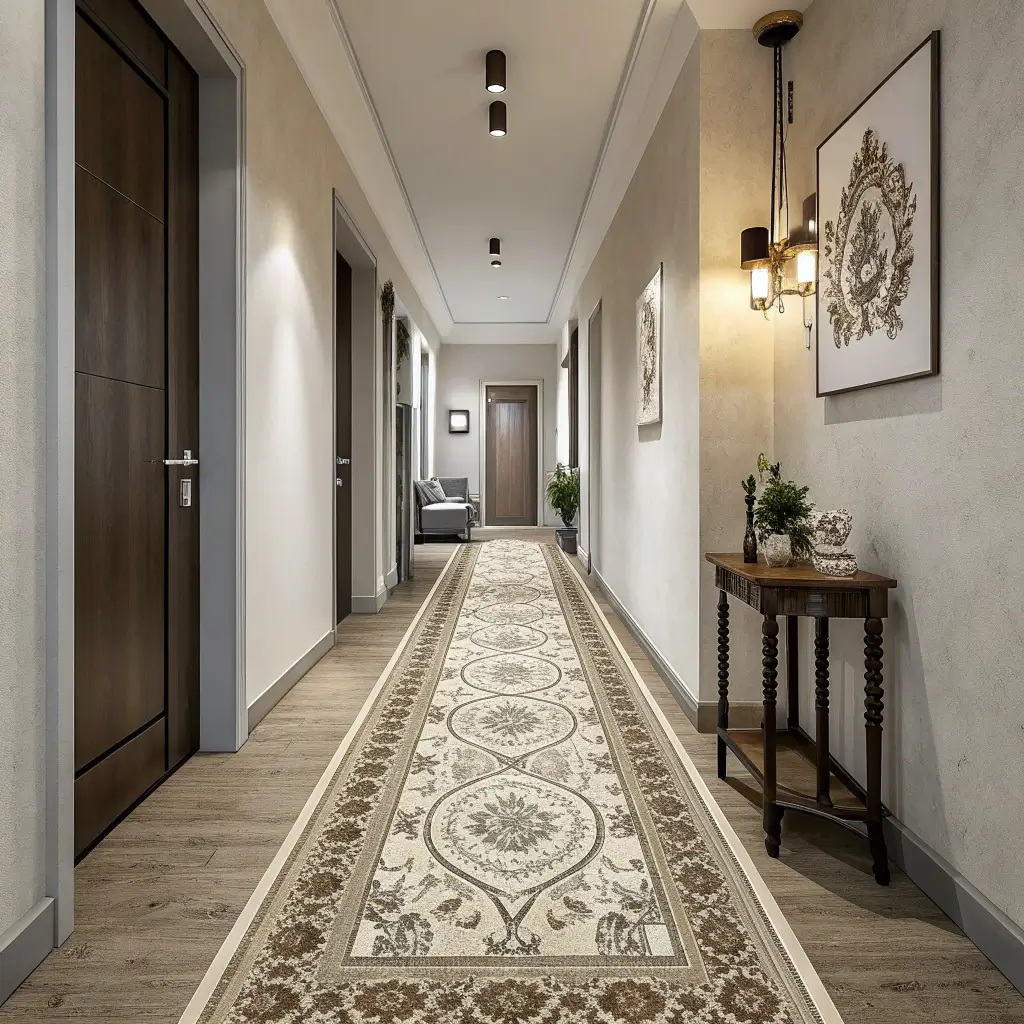
Choosing Patterns That Work
Runner rugs in hallways serve two purposes: protecting your floors and adding personality. But in narrow spaces, the wrong pattern can make you dizzy.
Avoid busy, all-over patterns. Instead, opt for simple geometrics or stripes that run lengthwise. They literally lead the eye down the hallway, creating an illusion of length.
Size and Placement Guidelines
The golden rule: leave 4-6 inches of floor visible on each side of your runner. Any wider and you’ll be tripping over edges. Any narrower and it looks like you bought the wrong size.
Length matters too. Either go for one long runner that covers most of the hallway, or multiple smaller runners with consistent spacing between them. That weird in-between length just looks awkward.
Material Considerations
Hallways get serious foot traffic, so durability trumps everything:
- Low-pile or flat-weave rugs are easiest to clean
- Natural fibers like jute look great but stain easily
- Washable runners are lifesavers (trust me on this)
- Always use a rug pad to prevent slipping
Wall-Mounted Lighting Fixtures
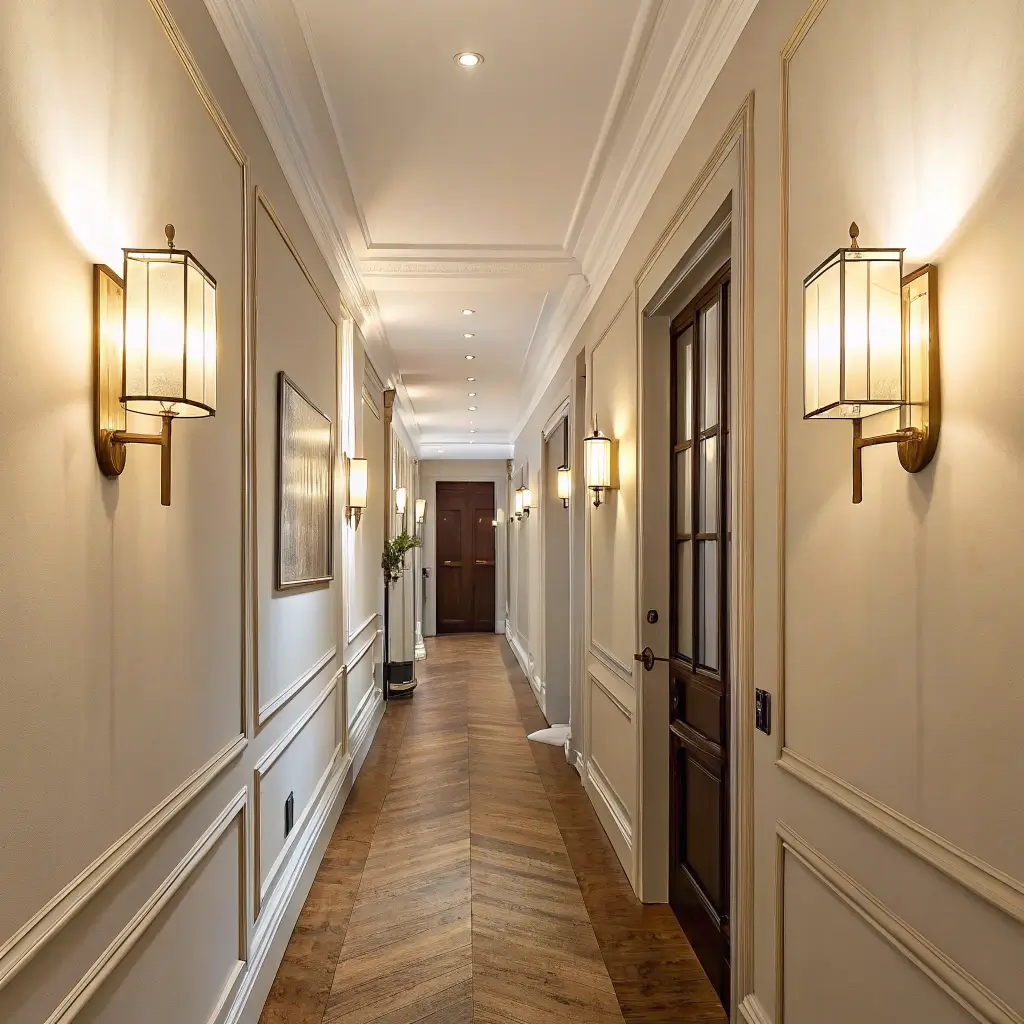
Sconces vs. Overhead Lighting
Overhead lighting in narrow hallways creates harsh shadows and makes the space feel like a hospital corridor. Wall sconces change everything by providing softer, more ambient light at eye level.
I replaced my single ceiling fixture with three wall sconces, and my hallway went from creepy to cozy instantly. The soft upward light makes the ceiling appear higher too.
Installation Without Rewiring
Don’t want to hire an electrician? Battery-operated LED sconces have become surprisingly sophisticated. Some even have remote controls and dimmer functions.
For a more permanent solution without rewiring:
- Plug-in sconces with cord covers
- Track lighting that uses existing ceiling fixtures
- LED strips with adhesive backing
Style and Brightness Considerations
Match your sconces to your home’s overall style, but keep them simple in design. Ornate fixtures look overwhelming in small spaces.
For brightness:
- 40-60 watts (or LED equivalent) per sconce
- Warm white bulbs (2700-3000K) for a cozy feel
- Install dimmers if possible for versatility
Also Read: 15 Bright Hallway Light Fixtures Ideas for Stylish Spaces
Hidden Storage Cabinets
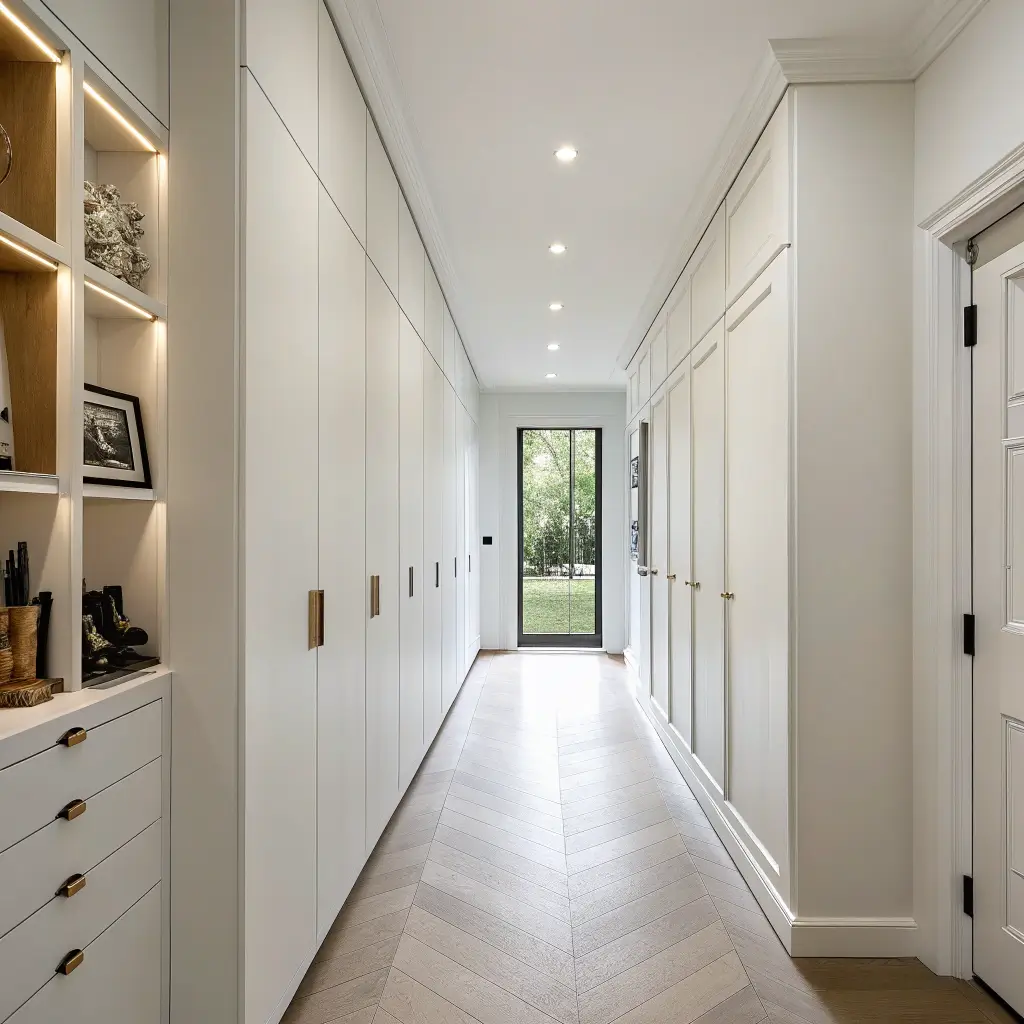
Maximizing Every Inch
Hidden storage in hallways is like finding money in your coat pocket – surprisingly satisfying. Recessed cabinets between wall studs give you storage without stealing any hallway width.
I had a contractor create a shallow medicine cabinet-style storage unit in my hallway wall. It holds cleaning supplies and extra toiletries, completely invisible behind a mirror front.
Creative Concealment Options
Think beyond traditional cabinets:
- Faux air vents that open to reveal storage
- Picture frames on hinges hiding shallow shelves
- Baseboards with pull-out drawers
- Hollow ottomans or benches with lift-tops
What to Store
Be strategic about what goes in hallway storage:
- Seasonal items (scarves, gloves, sunglasses)
- Cleaning supplies for quick touch-ups
- Extra batteries, lightbulbs, and household essentials
- Pet supplies if the hallway leads to outdoor access
Accent Wallpaper for Depth
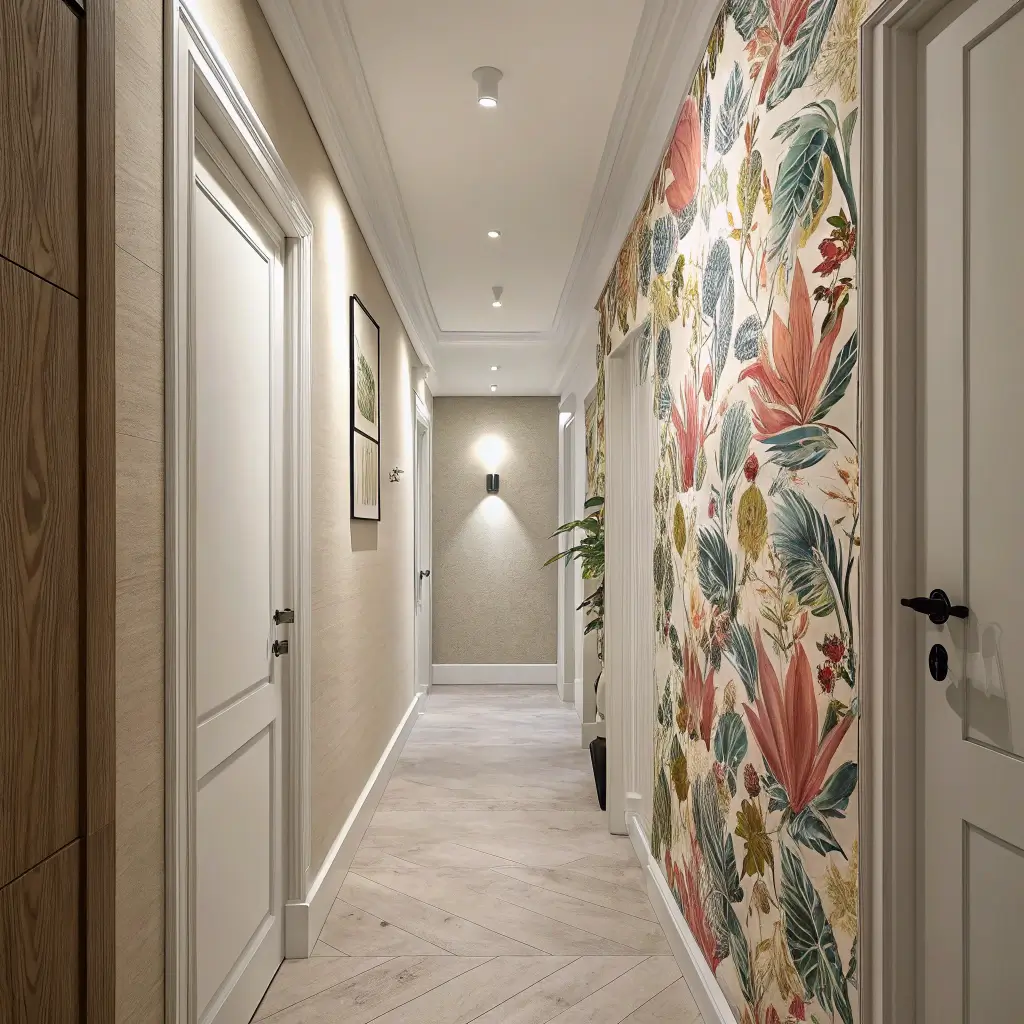
Pattern Selection for Small Spaces
Wallpaper in hallways can be tricky. Go too bold and you’ll feel claustrophobic. Too subtle and why bother? The sweet spot is medium-scale patterns with good contrast.
Vertical stripes are obvious choices, but don’t overlook subtle textures or tone-on-tone patterns. They add interest without overwhelming the eye.
Application Techniques
IMO, wallpapering just one wall (or even half a wall) often works better than going full coverage. I wallpapered just the upper half of my hallway walls with a grasscloth texture, and it added depth without feeling busy.
Consider these approaches:
- Ceiling only for an unexpected twist
- End wall as a focal point
- Wainscoting height with paint above
- Inside door frames for subtle detail
Temporary vs. Permanent Options
Renters, rejoice! Peel-and-stick wallpaper has gotten really good. I used it in my last apartment and it came off cleanly when I moved. Just test a small area first.
For permanent options, hire a pro if you’re not confident. Crooked wallpaper in a narrow hallway is painfully obvious and will haunt you daily.
Multi-Functional Seating Bench
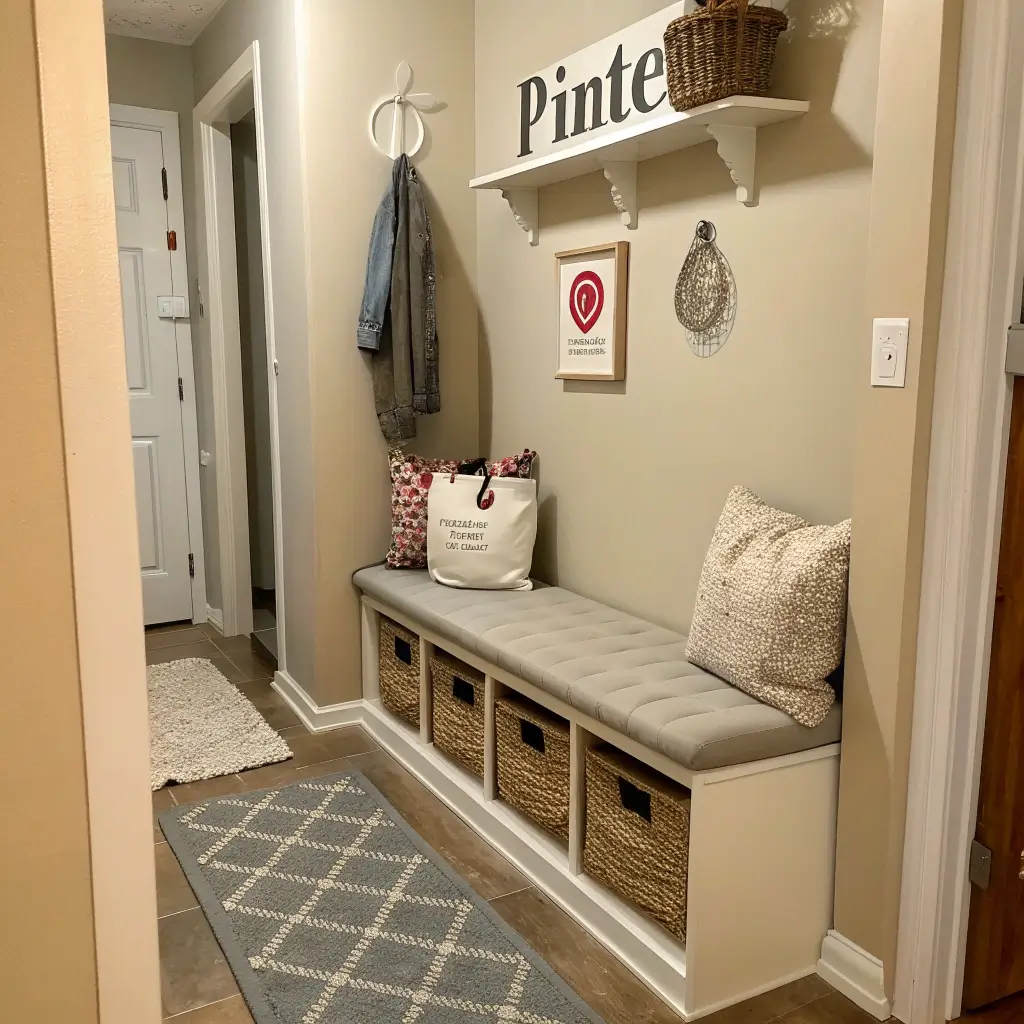
Seating That Earns Its Space
A bench in a tiny hallway might seem like overkill, but the right bench does triple duty: seating, storage, and style. The key is finding one slim enough to not impede traffic flow.
My entryway bench is only 14 inches deep but has shoe storage underneath and hooks on the side. It’s basically command central for our daily comings and goings.
Storage Integration Ideas
The best hallway benches hide their storage cleverly:
- Lift-top compartments for seasonal gear
- Open cubbies underneath for shoes
- Built-in baskets that slide out
- Side pockets for umbrellas or magazines
Placement Strategies
Position your bench where it makes sense functionally:
- Near the main entrance for putting on shoes
- At the end of a dead-end hallway as a focal point
- Under a window if you’re lucky enough to have one
- Against the longest wall to minimize obstruction
Also Read: 15 Charming Upstairs Hallway Ideas for Stunning Decor
Floating Shoe Rack Design
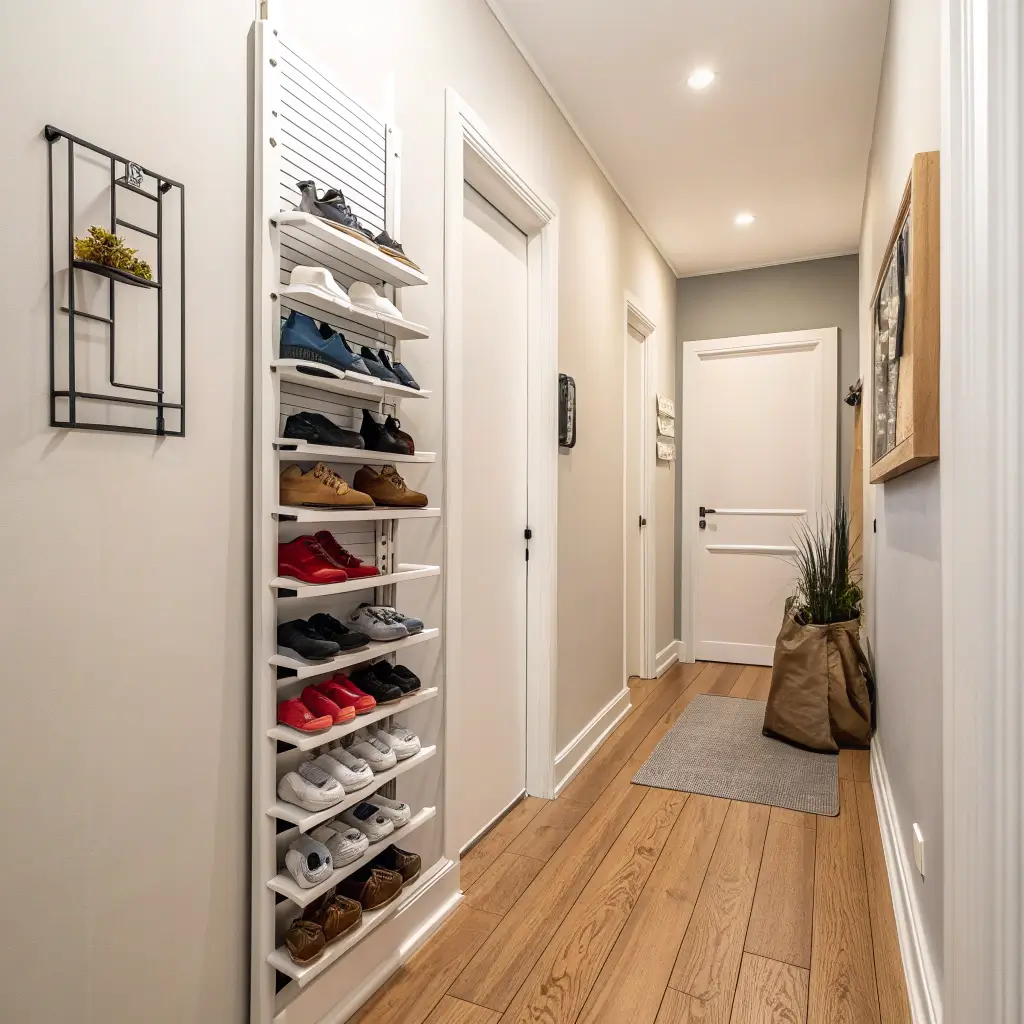
Vertical Solutions for Footwear
Shoes in hallways usually equal chaos. But floating shoe racks keep footwear organized and off the floor, making your hallway feel infinitely cleaner.
I installed a simple floating shoe rack that holds six pairs of everyday shoes. Everything else goes in the bedroom closet. This system forced me to be selective, which honestly improved my life.
DIY Floating Rack Ideas
You don’t need to buy expensive systems:
- Crown molding mounted at an angle holds heels perfectly
- Tension rods between walls for flat shoes
- Repurposed picture ledges work great for sneakers
- Wooden crates mounted sideways become instant cubbies
Keeping It Organized
The secret to shoe rack success? Strict rules about what stays:
- Current season only
- One pair per person for daily wear
- Guest slippers in a basket
- Everything else goes elsewhere
Overhead Storage Shelves
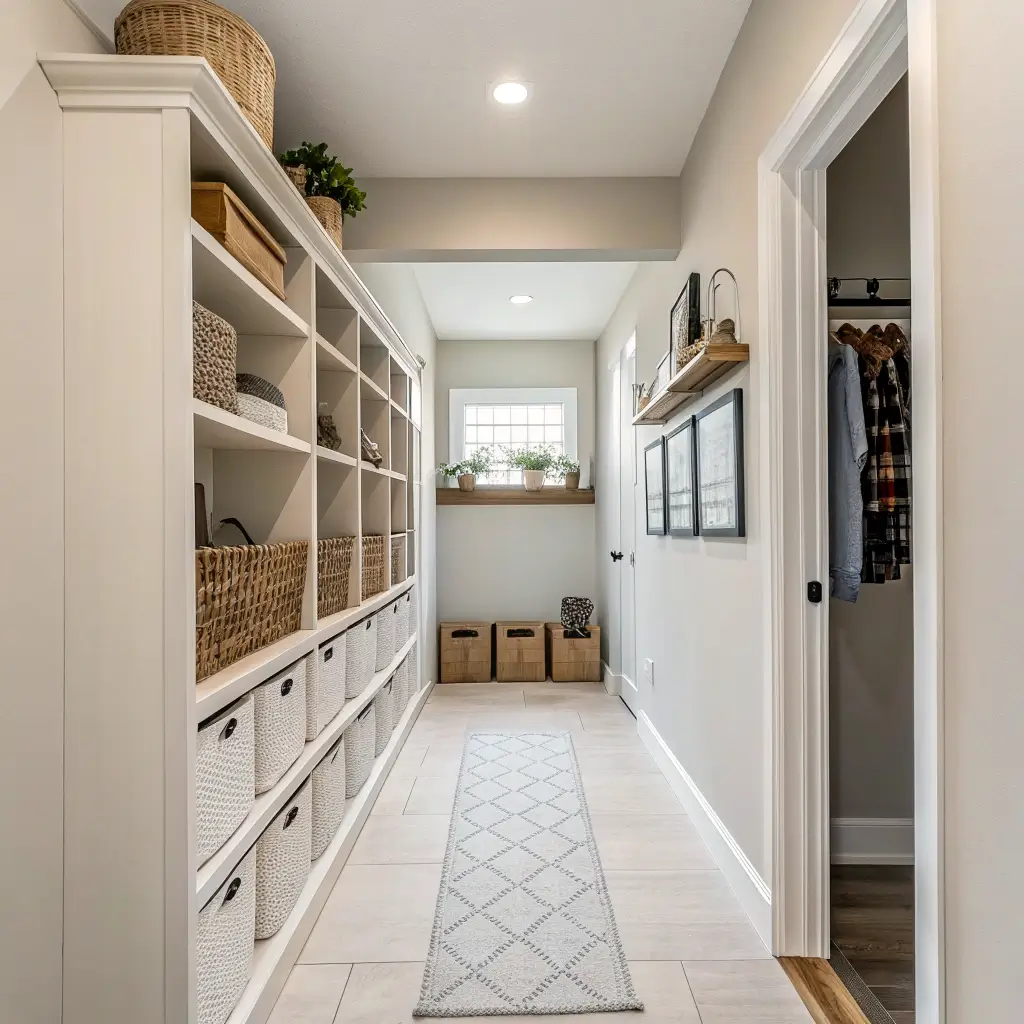
Using Ceiling Height Wisely
That space above your head in the hallway? It’s free real estate. Overhead storage shelves keep rarely-used items accessible but out of the way.
I installed a shelf 12 inches from my hallway ceiling for storing holiday decorations and extra linens. Can’t see it unless you look up, but it holds a ton of stuff.
Safety and Accessibility
Let’s be real about overhead storage:
- Secure mounting is non-negotiable (falling objects are dangerous)
- Store only lightweight items up high
- Keep a small stepstool nearby
- Label boxes clearly so you know what’s up there
Aesthetic Considerations
Overhead storage doesn’t have to look like a garage:
- Use matching baskets or boxes for a cohesive look
- Paint shelves the same color as walls to minimize visual impact
- Install lighting underneath to prevent shadow zones
- Keep the front edge clean and uncluttered
Bright Doors for Visual Expansion
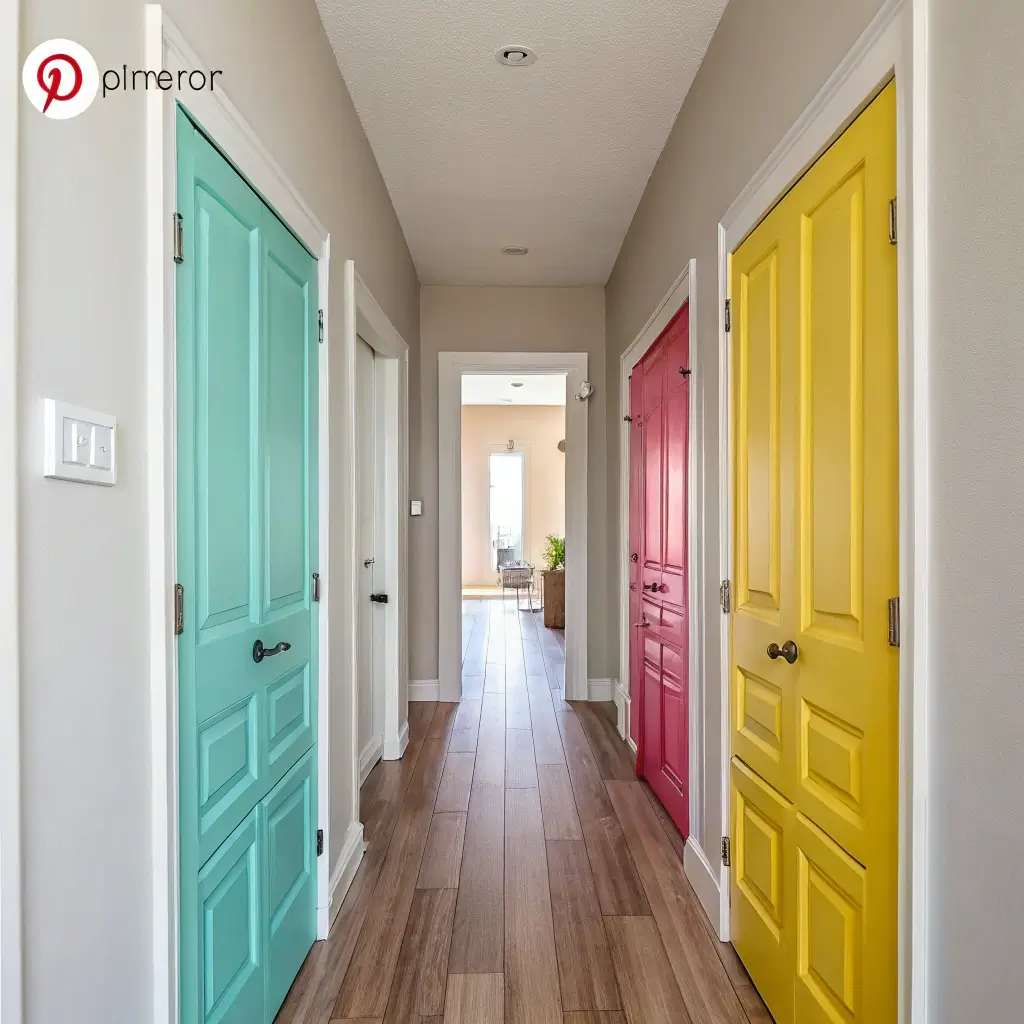
The Power of Painted Doors
Bright doors in hallways are like exclamation points – they add energy and draw the eye forward. A single colorful door can transform your entire hallway’s personality.
I painted my hallway closet door bright coral, and now it’s basically art. Guests always comment on it, and it makes me smile every time I walk past.
Color Selection Tips
Choose door colors based on your hallway’s natural light:
- North-facing hallways: warm colors like orange or yellow
- South-facing: cool blues or greens work well
- No natural light: go bold with jewel tones
- Multiple doors: vary shades of the same color family
Beyond Paint
Not ready to commit to colorful doors? Try these alternatives:
- Removable vinyl decals in geometric patterns
- Washi tape designs for renters
- Mirror panels on closet doors
- Chalkboard paint for family message centers
Conclusion
There you have it – fifteen ways to turn your cramped hallway into a functional, stylish space that actually makes sense. The biggest lesson I’ve learned? Small spaces force you to be creative, and that’s when the magic happens.
Start with one or two ideas that resonate with you. Maybe it’s mirrors to open up the space, or perhaps floating shelves to finally organize that clutter. Whatever you choose, remember that the best hallway is one that works for your lifestyle.
Your tiny hallway doesn’t have to be the forgotten stepchild of your home anymore. With some strategic planning and these clever solutions, it can become one of the hardest-working spaces you own. Now get out there and show that narrow corridor who’s boss!